Executive Summary · At a Glance
- ✓Crystal size dictates dissolution speed: fine salt dissolves instantly for foundational seasoning, while coarse salt delivers delayed, textural bursts.
- ✓Unrefined Himalayan pink rock salt from Pakistan retains essential iron, magnesium, calcium, and potassium without bleaching or anti-caking silicates.
- ✓Always season in layers: use fine salt early in the pan to penetrate foods, and coarse crystals at the pass to highlight texture.
- ✓Store pink salt in airtight glass jars away from direct stove steam to prevent clumping naturally.
Crystal Geometry: The Science of Dissolution#
Most home cooks keep a single container of salt on the counter and use it indiscriminately for every task—from salting pasta water to finishing a seared steak. While functional, treating all salt as interchangeable overlooks one of the most transformative elements in culinary craft: crystal geometry.
Salt is far more than a simple seasoning agent. Chemically, it acts as a catalytic driver that reduces water activity, softens bitterness, and amplifies the volatile aromatic compounds inherent in whole ingredients. How quickly or slowly a crystal dissolves across your tongue fundamentally changes how you perceive flavor, fat, and acidity.
Fine salt builds the foundational harmony of a dish from within; coarse salt delivers the dynamic punctuation mark on top.
The Khewra Difference: Why Ancient Rock Beats Table Salt#
Harvested from the subterranean seams of the ancient Khewra Salt Mine in Pakistan—one of the oldest and largest geological salt formations on Earth—unrefined pink rock salt was deposited when primordial oceans evaporated hundreds of millions of years ago. Sealed deep under continental tectonic pressure, these beds remained shielded from modern marine pollutants.
Unlike industrially refined white table salt, which is stripped of companion elements and treated with chemical anti-caking silicates, authentic pink salt retains its natural mineral balance. Trace elements of natural iron oxide lend the crystals their distinctive blush tone, while subtle notes of calcium, magnesium, and potassium contribute to a mild, rounded salinity that enhances ingredients without the harsh, stinging bite of chemical sodium chloride.
💡 Professional Insight
PRO TIP: When switching from iodized table salt to unrefined Himalayan pink salt, you may notice food tastes more complex rather than simply "salty." The natural companion minerals temper the initial sodium spike.
Fine Grain: The Master of Uniform Dispersion#
The smaller the crystal, the greater its surface area relative to mass—meaning fine-grain pink salt dissolves almost instantaneously upon contact with moisture. This makes fine salt an indispensable tool for foundational seasoning:
- •Baking & Doughs: Because fine grains distribute evenly through dry flours, they ensure consistent gluten development and balanced flavor throughout breads, pastries, and pizza crusts without leaving pockets of sharp salinity.
- •Stocks, Soups & Sauces: Fine salt dissolves rapidly into warm broths, allowing you to gauge and adjust foundational seasoning accurately without waiting for large crystals to break down.
- •Marinades & Brines: When preparing marinades for proteins or dressings for leafy greens, fine salt blends seamlessly into vinegars, citrus juices, and olive oils.
Coarse Grain: Crunch, Grinders & The Artisanal Finish#
Coarse salt crystals are designed not to disappear, but to linger. Their larger surface and density create deliberate textural contrast and intermittent bursts of clean salinity that punctuate a meal.
- •Finishing Roasted Meats & Seafood: Crushing coarse pink crystals over a resting ribeye, roasted chicken, or seared salmon right before serving creates a crisp crunch against tender textures.
- •Artisanal Grinders & Mills: Coarse crystals are built specifically for ceramic grinders, allowing you to calibrate grain size dynamically depending on the dish at hand.
- •Fresh Produce & Salads: Sprinkled over vine-ripened heirloom tomatoes, sliced avocados, or cold melon, coarse crystals draw out just enough surface juice to create an instant, shimmering vinaigrette.
Side-by-Side: Fine vs. Coarse Comparison Table#
| Feature | Fine Grain Pink Salt | Coarse Grain Pink Salt |
|---|---|---|
| Dissolution Speed | Instantaneous (< 5 seconds) | Slow & Gradual (30+ seconds) |
| Primary Culinary Role | Foundational seasoning, baking, broths | Finishing crunch, grinders, salt crusts |
| Best Equipment | Salt cellar, pinch bowl, shaker | Ceramic burr grinder, mortar & pestle |
| Ideal Dishes | Sourdough, braises, stocks, marinades | Grilled steak, roasted vegetables, crudo |
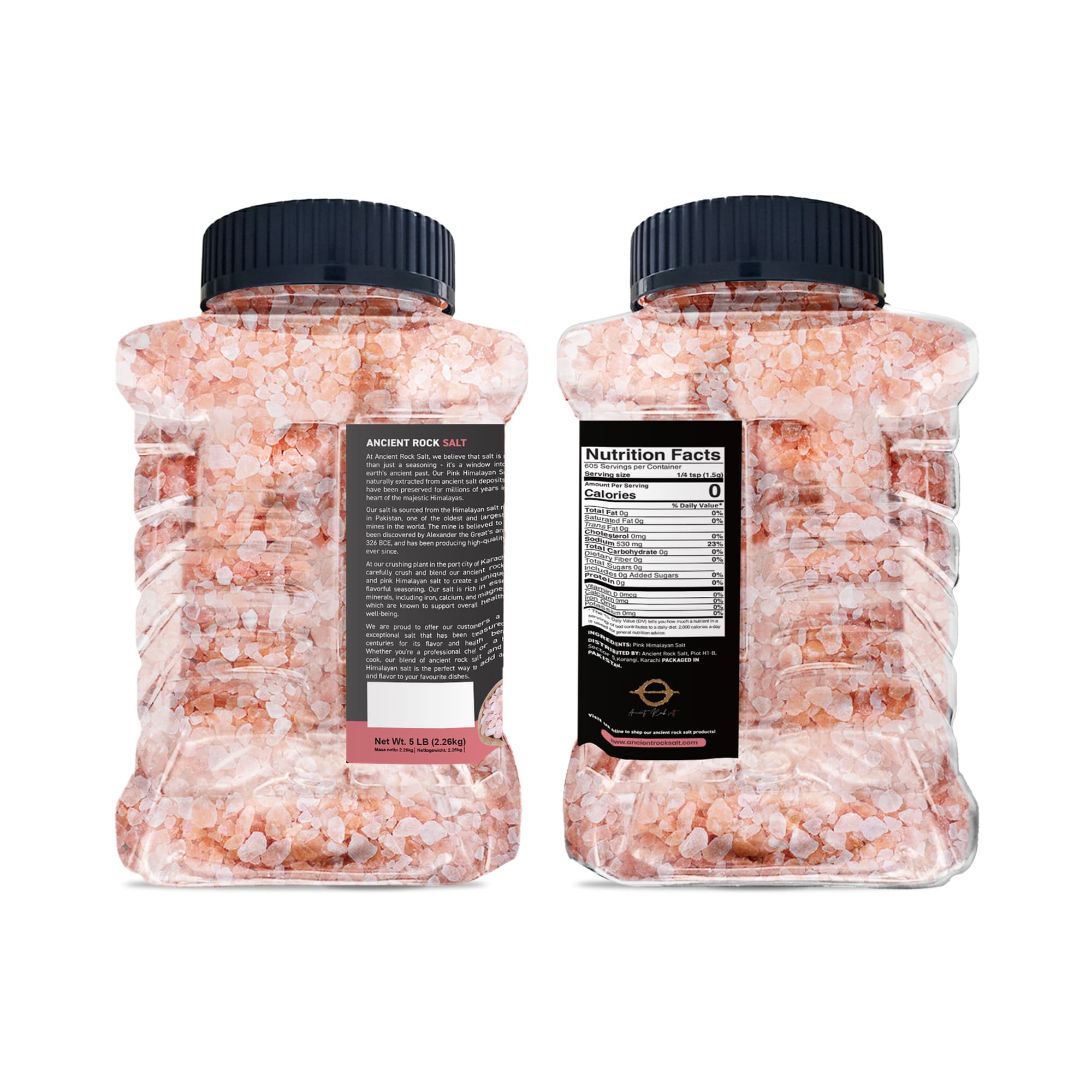
| Available Formats | 2 lb resealable pouch & 5 lb grip jar | 2 lb resealable pouch & 5 lb grip jar |
The Three-Stage Seasoning Rule: Building Depth#
Great cooking relies on layering salt at distinct points during food preparation rather than dumping a heavy handful at the end:
- •Stage 1 (At the Beginning): Light fine pink salt directly onto raw aromatics (onions, garlic, celery) to sweat moisture and concentrate savory sugars.
- •Stage 2 (During the Simmer): Taste sauces and broths midway through reduction and adjust with fine salt so flavors coalesce smoothly.
- •Stage 3 (At the Pass): Finish immediately before plating with coarse crystals to provide visual brilliance, mineral nuance, and crunchy sensory delight.
Preserving Crystal Integrity: Moisture & Storage#
Because authentic Himalayan rock salt contains zero artificial anti-caking silicates or flow agents, it remains sensitive to environmental moisture. Store your cooking salt in a cool, dry pantry inside a glass jar with an airtight seal. Keep ceramic grinders away from bubbling pots during heavy boiling to avoid steam condensation inside the burr chamber.

About the Author
Chef Tariq Mansoor
Chef Tariq has spent over fifteen years working with artisanal salts and unrefined mineral seasoning across commercial kitchens in South Asia and North America.